
We'll explore how to use Gemini to handle common work tasks, helping you save time and boost efficiency. This lesson will cover:
- Guidelines for using Gemini in a work environment
- Practical applications, including:
- Customer Service: Enhancing response quality and speed
- Content Generation: Brainstorming, outlining, and drafting various content formats
- Human Resources: Facilitating internal communication, crafting hiring posts, and managing logistics reports
- Sales: Understanding customer pain points and personalizing outreach
- Programming: Offering coding assistance and clarifying complex concepts
- Integrating Gemini into your workflow
Guidelines for Using Gemini at Work
Gemini can streamline your workflow, making you more efficient and productive. However, using it strategically in a work context is crucial. Here are some guidelines to ensure Gemini becomes a valuable asset in your workday:
- Gemini is a Tool: It’s meant to assist, not replace your expertise. While Gemini can automate repetitive tasks, it isn’t a substitute for your professional judgment and decision-making skills. Consider it a powerful tool that complements your expertise.
- Privacy: Be cautious with sensitive information. Avoid sharing confidential company data, personal details of customers or colleagues, or any other information that shouldn’t be made public.
- Tailor to Your Role: Every job is unique. Adapt the example prompts provided in this course to fit your specific tasks and industry. This might involve adjusting the tone, incorporating industry-specific terms, or focusing on goals relevant to your field.
Practical Applications
Let’s delve into some work-related scenarios where Gemini can be particularly useful.
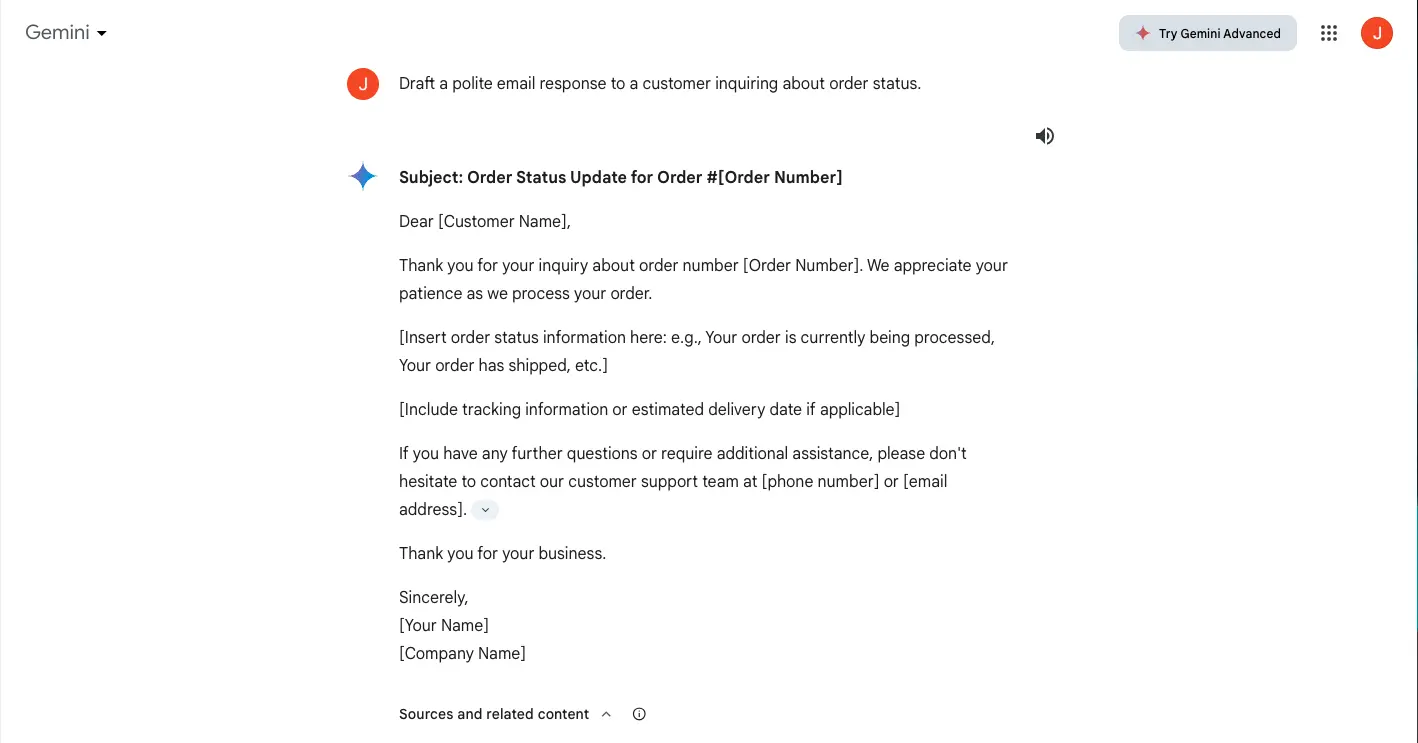
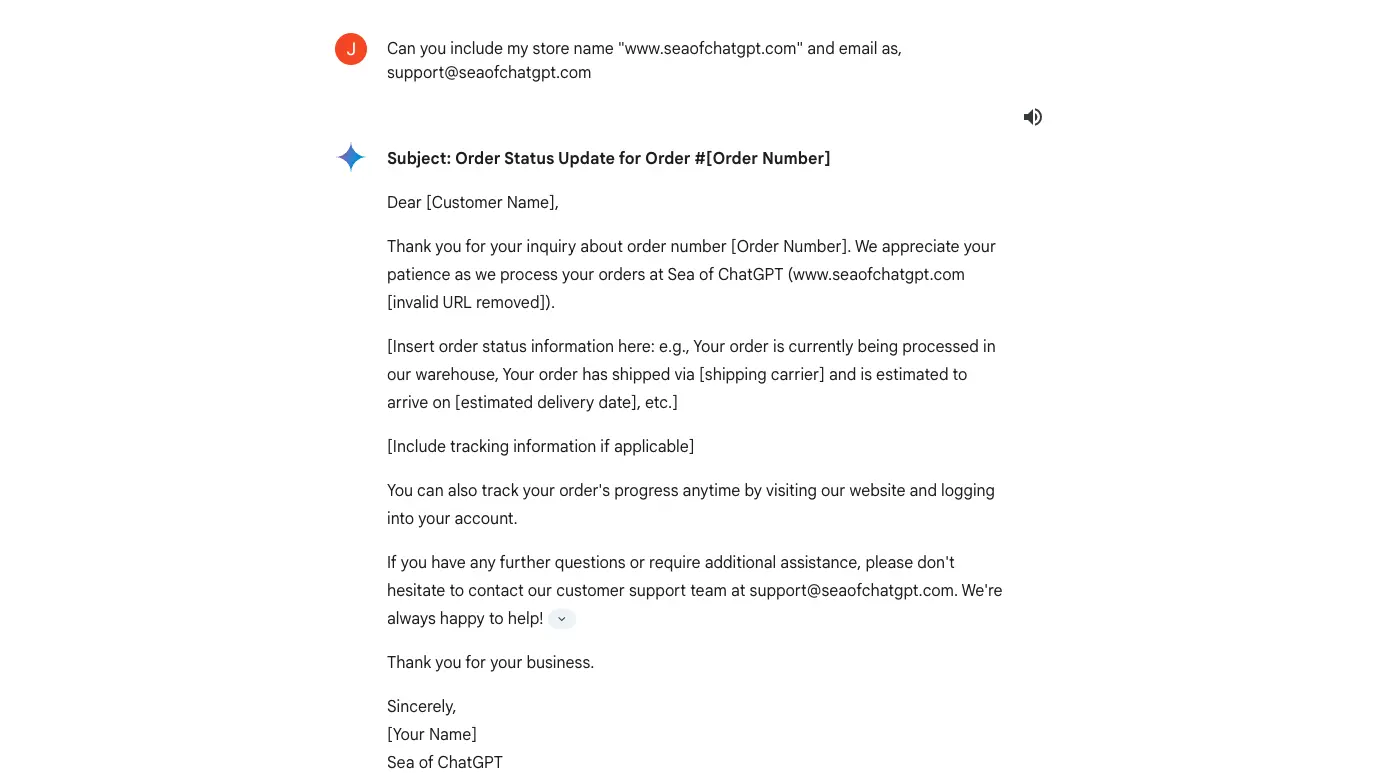
Draft a polite email response to a customer inquiring about order status
Programming
- Code Generation: Generate code snippets based on specific requirements or problems.
- Code Explanation: Explain complex code logic or algorithms.
- Debugging Assistance: Help identify and fix errors in code.
- Test Case Generation: Create test cases for software applications.
Examples:
- "Generate Python code to implement a quicksort algorithm."
- "Create a JavaScript function to check if a number is a palindrome."
- "Write a SQL query to find the top 5 customers by total purchase amount."
- "Explain the time complexity of merge sort in simple terms."
- "Break down the following Python code line by line:
def factorial(n):." - "Describe the purpose of a hash table data structure."
- "My Python code is producing an 'IndexError: list index out of range' error. How can I fix it?"
- "The JavaScript function is not returning the expected output. Please help me debug it."
- "My C++ code is crashing. Can you help me identify the potential causes?"
- "Create unit test cases for a function that checks if a string is a valid email address."
- "Generate test cases for a Python class that represents a bank account."
- "Write test cases to cover different scenarios for a sorting algorithm."
Python Quicksort
Prompt: Generate Python code to implement a quicksort algorithm.
Python
def quicksort(arr):
 """Sorts an array using the quicksort algorithm."""
 if len(arr) <= 1:
 return arr
 pivot = arr[len(arr) // 2]
 left = [x for x in arr if x < pivot]
 middle = [x for x in arr if x == pivot]
 right = [x for x in arr if x > pivot]
 return quicksort(left) + middle + quicksort(right)

# Example usage:
unsorted_list   = [3, 7, 8, 5, 2, 1, 9, 6, 4]
sorted_list = quicksort(unsorted_list)
print(sorted_list) # Output: [1, 2, 3, 4, 5, 6, 7, 8, 9]
Use code with caution.
JavaScript Palindrome Check
Prompt: Create a JavaScript function to check if a number is a palindrome.
JavaScript
function isPalindrome(num) {
 const str = num.toString();
 const reversedStr = str.split('').reverse().join('');
 return str === reversedStr;
}

// Example usage:
console.log(isPalindrome(121));   // Output: true
console.log(isPalindrome(123)); // Output: false
Use code with caution.
SQL Query for Top Customers
Prompt: Write a SQL query to find the top 5 customers by total purchase amount.
Assuming a table named orders with columns customer_id and total_amount:
SQL
SELECT customer_id, SUM(total_amount) as total_spent
FROM orders
GROUP BY customer_id
ORDER BY total_spent DESC
LIMIT 5;
Use code with caution.
This query calculates the total spent for each customer, orders the results by total spent in descending order, and limits the output to the top 5 customers.
Note: The specific table and column names might vary depending on your database schema.
Sales
- Sales Email Templates: Create personalized email templates for different customer segments.
- Sales Pitch Development: Assist in developing persuasive sales pitches and presentations.
- Customer Analysis: Analyze customer data to identify potential opportunities and challenges.
- Product Comparison: Compare product features and benefits to competitors.
Examples:
- "Create a cold email template targeting tech startups for a cloud-based CRM solution."
- "Develop a follow-up email template for a potential client who expressed interest in our marketing automation software."
- "Write a personalized email template to upsell a premium subscription to existing customers."
- "Develop a sales pitch for a new customer relationship management (CRM) software focusing on increased sales efficiency."
- "Create a sales presentation outline for a SaaS product that automates social media marketing."
- "Develop key selling points for a new line of eco-friendly cleaning products."
- "Analyze customer purchase history data to identify cross-selling opportunities."
- "Identify potential customer segments based on demographic and behavioral data."
- "Analyze customer churn data to determine reasons for customer attrition."
Human Resources
- Job Description Creation: Generate job descriptions tailored to specific roles and company culture.
- Interview Question Generation: Develop a variety of interview questions based on different job roles.
- Employee Onboarding: Create welcome emails, training materials, and company culture guides.
- Performance Review Feedback: Provide suggestions for performance review feedback based on employee goals and accomplishments.
Examples:
- "Write a job description for a Senior Marketing Manager position at a tech startup, emphasizing a data-driven approach and strong leadership skills."
- "Create a job description for a remote customer support representative, highlighting the importance of empathy and problem-solving abilities."
- "Develop behavioral interview questions for a software engineer position focusing on problem-solving and teamwork."
- "Create a list of technical interview questions for a data analyst role, assessing SQL, Python, and data visualization skills."
- "Write a welcome email for new hires at a creative agency, emphasizing company culture and team collaboration."
- "Create an onboarding checklist for a sales representative role, including training modules and key contacts."
- "Provide performance review feedback for an employee who consistently exceeds expectations in their role as a project manager."
- "Offer constructive feedback for an employee who is struggling to meet sales targets, focusing on areas for improvement and development."
Content Generation
- Blog Post Creation: Generate blog post ideas, outlines, and even draft content based on specific keywords or topics.
- Social Media Content: Create engaging social media posts, captions, and ad copy.
- Email Campaigns: Write compelling email subject lines, body copy, and calls to action.
- Product Descriptions: Develop detailed and persuasive product descriptions.
Example:
- Generate blog post ideas: "Brainstorm blog post topics related to [niche/industry], targeting a [target audience]."
- Create blog post outline: "Create a detailed outline for a blog post about [topic], targeting [keyword]."
- Draft blog post content: "Write a blog post about [topic] with a focus on [angle], targeting [audience]. Include [keywords]."
- Create social media post: "Write a captivating Instagram caption about [topic] using [tone]."
- Generate social media ad copy: "Create ad copy for a Facebook ad promoting , targeting [audience]."
- Develop social media campaign: "Create a social media campaign for with a focus on [goal]."