Claude can be used in a wide range of areas. Here's a list of broad categories where I can be helpful:
- Research and Analysis
- Writing and Editing
- Programming and Software Development
- Data Processing and Interpretation
- Education and Tutoring
- Creative Tasks
- Problem-Solving and Strategic Planning
- Language Translation and Interpretation
- Mathematical Calculations and Modeling
- Task Automation and Workflow Optimization
- Customer Service and Support
- Healthcare Information and Assistance
- Legal Research and Documentation
- Financial Analysis and Planning
- Environmental and Sustainability Studies
- Historical and Cultural Studies
- Technology Trends and Analysis
- Business Strategy and Management
- Scientific Research Assistance
- Ethics and Philosophy Discussions
We will see few examples below.
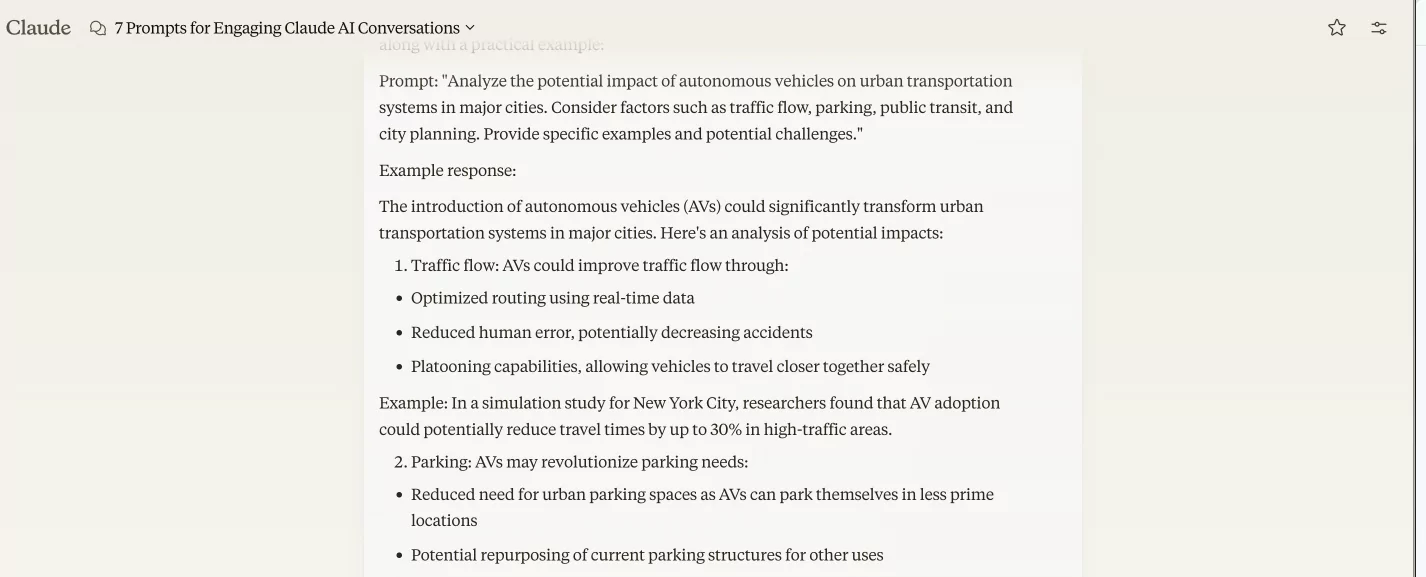
Prompt: "Analyze the potential impact of autonomous vehicles on urban transportation systems in major cities. Consider factors such as traffic flow, parking, public transit, and city planning. Provide specific examples and potential challenges."
Example response:
The introduction of autonomous vehicles (AVs) could significantly transform urban transportation systems in major cities. Here's an analysis of potential impacts:
- Traffic flow: AVs could improve traffic flow through:
- Optimized routing using real-time data
- Reduced human error, potentially decreasing accidents
- Platooning capabilities, allowing vehicles to travel closer together safely
Example: In a simulation study for New York City, researchers found that AV adoption could potentially reduce travel times by up to 30% in high-traffic areas.
- Parking: AVs may revolutionize parking needs:
- Reduced need for urban parking spaces as AVs can park themselves in less prime locations
- Potential repurposing of current parking structures for other uses
Prompt: "Design a RESTful API for a simple task management system. Include endpoints for creating, reading, updating, and deleting tasks. Provide sample request/response structures for each endpoint and suggest appropriate HTTP status codes. Then, implement the API design in Python using the Flask framework."
Example response:
Here's a design for a RESTful API for a simple task management system:
- Create Task
- Endpoint: POST /tasks
- Request body: {"title": "string", "description": "string", "due_date": "YYYY-MM-DD"}
- Response: 201 Created, {"id": "integer", "title": "string", "description": "string", "due_date": "YYYY-MM-DD", "created_at": "YYYY-MM-DD HH:MM:SS"}
- Get All Tasks
- Endpoint: GET /tasks
- Response: 200 OK, [{"id": "integer", "title": "string", "description": "string", "due_date": "YYYY-MM-DD", "created_at": "YYYY-MM-DD HH:MM:SS"}, ...]
- Get Single Task
- Endpoint: GET /tasks/{task_id}
- Response: 200 OK, {"id": "integer", "title": "string", "description": "string", "due_date": "YYYY-MM-DD", "created_at": "YYYY-MM-DD HH:MM:SS"}
- Update Task
- Endpoint: PUT /tasks/{task_id}
- Request body: {"title": "string", "description": "string", "due_date": "YYYY-MM-DD"}
- Response: 200 OK, {"id": "integer", "title": "string", "description": "string", "due_date": "YYYY-MM-DD", "created_at": "YYYY-MM-DD HH:MM:SS"}
- Delete Task
- Endpoint: DELETE /tasks/{task_id}
- Response: 204 No Content
Now, let's implement this API design using Python and Flask:
from flask import Flask, request, jsonify
from datetime import datetime
import sqlite3

app = Flask(__name__)

def get_db_connection():
 conn = sqlite3.connect('tasks.db')
 conn.row_factory = sqlite3.Row
 return conn

@app.route('/tasks', methods=['POST'])
def create_task():
 task_data = request.json
 conn = get_db_connection()
 cursor = conn.cursor()
 cursor.execute('INSERT INTO tasks (title, description, due_date) VALUES (?, ?, ?)',
 (task_data['title'], task_data['description'], task_data['due_date']))
 conn.commit()
 task_id = cursor.lastrowid
 cursor.execute('SELECT * FROM tasks WHERE id = ?', (task_id,))
 task = cursor.fetchone()
 conn.close()
 return jsonify(dict(task)), 201

@app.route('/tasks', methods=['GET'])
def get_all_tasks():
 conn = get_db_connection()
 tasks = conn.execute('SELECT * FROM tasks').fetchall()
 conn.close()
 return jsonify([dict(task) for task in tasks]), 200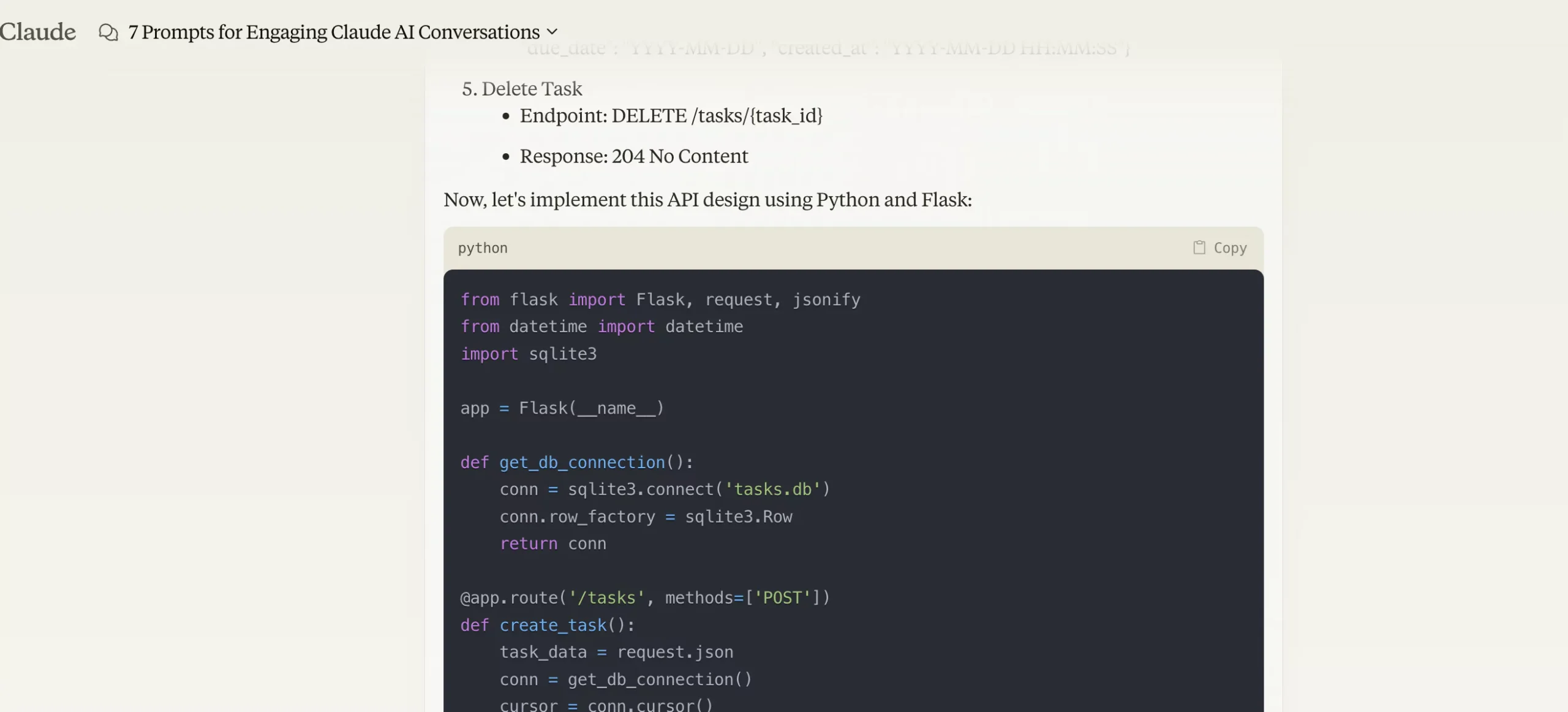
Prompt: "Translate the following English text into Spanish, French, and German. Then, provide a brief analysis of the key challenges in translating this particular text, considering cultural nuances and idiomatic expressions:
'The early bird catches the worm, but the second mouse gets the cheese. Life is full of unexpected twists and turns, so always keep your eyes peeled for opportunities.'"
Example response:
Spanish: "El que madruga, Dios le ayuda, pero el segundo ratón se lleva el queso. La vida está llena de giros inesperados, así que mantén siempre los ojos bien abiertos para detectar oportunidades."
French: "L'avenir appartient à ceux qui se lèvent tôt, mais c'est le deuxième souris qui obtient le fromage. La vie est pleine de rebondissements inattendus, alors gardez toujours l'œil ouvert pour saisir les opportunités."
German: "Der frühe Vogel fängt den Wurm, aber die zweite Maus bekommt den Käse. Das Leben steckt voller unerwarteter Wendungen, also halte immer die Augen offen nach Gelegenheiten."
Prompt: Give me top 5 trending technology in science and tec world.
Here are five trending technologies in the science and tech world as of early 2024:
- Artificial Intelligence (AI) and Machine Learning AI continues to be at the forefront of technological advancements, with particular focus on large language models, generative AI, and AI ethics. Applications span across various sectors including healthcare, finance, and autonomous systems.
- Quantum Computing Progress in quantum computing is accelerating, with major tech companies and startups working on developing more powerful and stable quantum processors. This technology has the potential to revolutionize fields like cryptography, drug discovery, and complex system modeling.
- Biotechnology and CRISPR gene editing Advancements in biotechnology, particularly in CRISPR gene editing techniques, are opening new possibilities in medicine, agriculture, and synthetic biology. This includes potential treatments for genetic disorders and the development of more resilient crops.
- Extended Reality (XR) - including Virtual Reality (VR) and Augmented Reality (AR) XR technologies are gaining traction beyond gaming, with applications in education, healthcare, industrial design, and remote collaboration. The development of more advanced and accessible XR devices is driving this trend.
- Sustainable Energy Technologies With increasing focus on climate change, technologies related to renewable energy, energy storage, and grid optimization are seeing rapid development. This includes advancements in solar cell efficiency, next-generation batteries, and smart grid systems.
Prompt: Can you tell me why there are ethical consideration for communicating tribes in Andaman.
The ethical considerations surrounding communication with tribes in the Andaman Islands, particularly the Sentinelese and other indigenous groups, are complex and multifaceted. Here are some key reasons why this topic raises ethical concerns:
- Protection from disease: These isolated tribes have limited immunity to common diseases from the outside world. Contact could introduce pathogens that could devastate their population.
- Cultural preservation: These tribes have unique cultures and ways of life that have remained largely unchanged for thousands of years. Contact with the outside world could lead to rapid cultural erosion.
- Right to self-determination: There's an ethical argument that these tribes have the right to choose whether they want contact with the outside world. Forced contact would violate this principle.
- Historical context: Past contacts between isolated tribes and outsiders have often led to exploitation, violence, and cultural destruction. This history informs current protective policies.
- Legal protection: The Indian government has laws protecting these tribes and restricting access to their territories. Attempting contact could violate these legal protections.
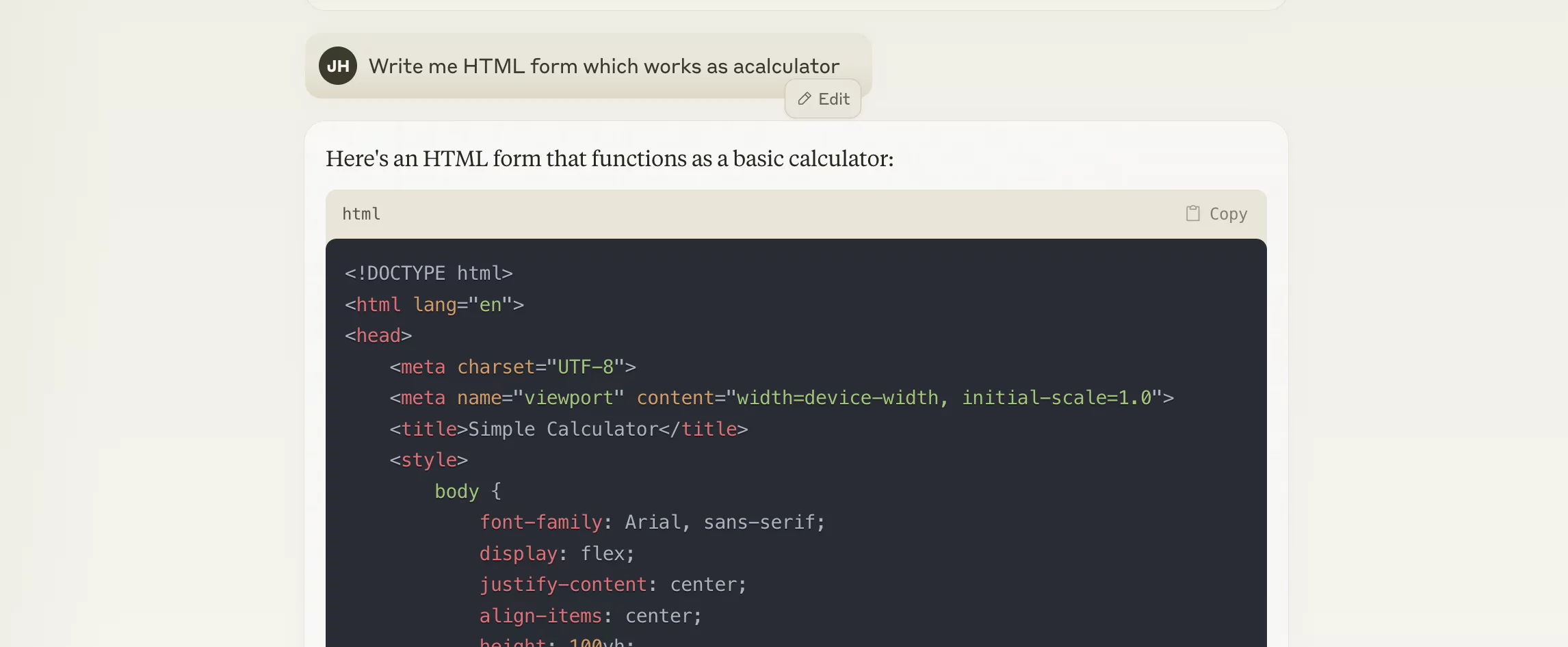
Prompt: Write me HTML form which works as a calculator
Here's an HTML form that functions as a basic calculator:
<!DOCTYPE html>
<html lang="en">
<head>
 <meta charset="UTF-8">
 <meta name="viewport" content="width=device-width, initial-scale=1.0">
 <title>Simple Calculator</title>
 <style>
 body {
 font-family: Arial, sans-serif;
 display: flex;
 justify-content: center;
 align-items: center;
 height: 100vh;
 margin: 0;
 background-color: #f0f0f0;
 }
 .calculator {
 background-color: #fff;
 padding: 20px;
 border-radius: 8px;
 box-shadow: 0 0 10px rgba(0,0,0,0.1);
 }
 input[type="number"], select, input[type="submit"] {
 margin: 5px;
 padding: 5px;
 }
 #result {
 margin-top: 10px;
 font-weight: bold;
 }
 </style>
</head>
<body>
 <div class="calculator">
 <form id="calculatorForm">
 <input type="number" id="num1" required placeholder="Enter first number">
 <select id="operator">
 <option value="+">+</option>
 <option value="-">-</option>
 <option value="*">×</option>
 <option value="/">÷</option>
 </select>
 <input type="number" id="num2" required placeholder="Enter second number">
 <input type="submit" value="Calculate">
 </form>
 <div id="result"></div>
 </div>

 <script>
 document.getElementById('calculatorForm').addEventListener('submit', function(e) {
 e.preventDefault();

 const num1 = parseFloat(document.getElementById('num1').value);
 const num2 = parseFloat(document.getElementById('num2').value);
 const operator = document.getElementById('operator').value;
 let result;

 switch(operator) {
 case '+':
 result = num1 + num2;
 break;
 case '-':
 result = num1 - num2;
 break;
 case '*':
 result = num1 * num2;
 break;
 case '/':
 result = num1 / num2;
 break;
 }

 document.getElementById('result').textContent = `Result: ${result}`;
 });
 </script>
</body>
</html>
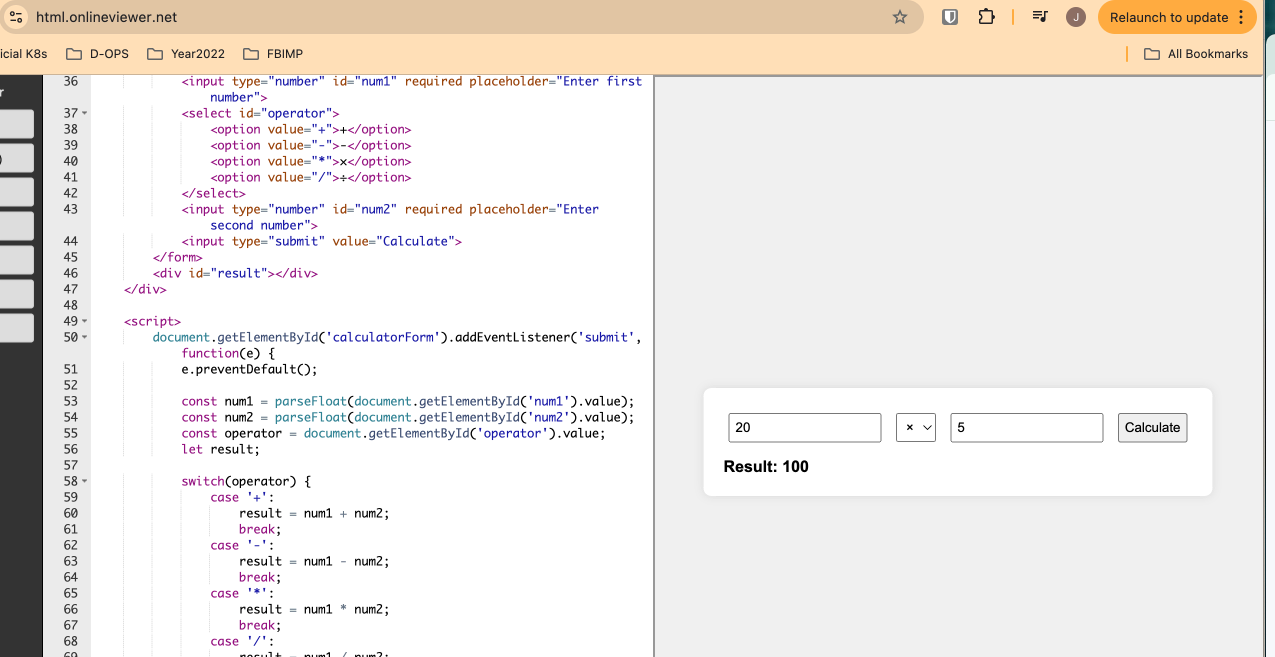
This HTML file creates a simple calculator form with the following features:
- Two input fields for entering numbers
- A dropdown menu to select the operation (+, -, ×, ÷)
- A "Calculate" button to perform the operation
- A result display area